



On a humid evening in Mumbai, Amitabh Bachchan steps onto the set of Kaun Banega Crorepati. There is nothing overtly dramatic about what he is wearing—no bold logos, no aggressive branding, no fast-fashion flash. Yet, episode after episode, viewers notice something else: texture over trend, fabric over fashion, comfort over spectacle. It is a subtle cue, but a powerful one.
At the same time, in Mann Ki Baat addresses and public appearances, Prime Minister Narendra Modi continues to repeat a phrase that has slowly seeped into India’s cultural vocabulary: “Vocal for Local.” Initially dismissed by some as political rhetoric, the phrase has, over the last two to three years, taken on a life of its own—reshaping how Indians think about consumption, identity, and value.
In between these two seemingly unrelated moments—a television wardrobe and a national call—lies a quiet but profound shift underway in India’s fashion landscape. Indian consumers are no longer merely rediscovering handloom; they are reclaiming it as contemporary, aspirational, and sustainable fashion.
This shift did not arrive with slogans or sudden revolutions. It emerged gradually, almost imperceptibly, through lived experience:
The fatigue of fast fashion—and the return to comfort
Over the years, Indian cities have grown hotter, seasons have become more erratic, and daily life has become more physically demanding. Synthetic-heavy fast fashion, once celebrated for affordability and trendiness, has begun to feel increasingly misaligned with India’s climate reality. Polyester does not breathe well in 45-degree summers. Short garment lifespans feel wasteful when prices rise. Disposable fashion loses its charm when environmental crises feel personal.
Consumers may not articulate this shift in academic terms, but their choices reflect it. Breathable cottons, airy linens, handwoven silks, khadi, ikat, jamdani, chanderi, kala cotton—fabrics once associated with “ethnic” or “occasional” wear—are quietly moving into everyday wardrobes. What was once reserved for festivals and other occasions is now worn in offices, studios, universities, and even television studios.
This is not nostalgia. It is functional intelligence. Handloom fabrics work for Indian bodies, Indian climates, and Indian lifestyles. Their sustainability is not an added feature—it is embedded in their very making.
When policy becomes culture
The Vocal for Local call gained traction not because it demanded sacrifice, but because it reframed local consumption as intelligent and dignified. Over the last two to three years, this narrative has been reinforced through national-level initiatives—handloom days, artisan showcases, GI tagging of textiles, exhibitions, and awards honouring weavers and craft communities.
What is significant is not the policy itself, but the cultural permission it provided. For decades, Indian consumers internalised the idea that imported meant superior. Wearing global brands signalled success; wearing local textiles signalled compromise. That hierarchy is now visibly weakening.
Local is no longer positioned as “less than.” It is increasingly branded as responsible, rooted, and forward-looking.
Celebrity influence without endorsement
The role of celebrities in this shift deserves careful attention—not because of advertisements, but because of normalisation. When public figures like Amitabh Bachchan consistently appear in garments that prioritise fabric, tailoring, and longevity over logos, it sends a quiet signal. When political leaders choose khadi or handwoven textiles not just for ceremonies but for everyday public engagement, it repositions these fabrics as lived choices rather than symbolic costumes.
What makes this powerful is precisely its lack of explanation. There is no campaign telling viewers to buy handloom. There is no lecture on sustainability. The fabric exists—confidently, repeatedly, and visibly.
In fashion psychology, repetition without justification is how aspiration shifts.
Sustainability that does not announce itself
For years, “Sustainability in Fashion in India” was discussed mainly in academic circles or NGO reports. It was framed as an ethical obligation rather than a personal benefit. What has changed recently is that sustainability has become experiential.
Handloom fabrics last longer. They age gracefully. They feel better on the skin. They adapt to seasonal changes. Consumers discover these qualities first—and only later recognise that they are also environmentally sound. Low energy production, minimal mechanisation, reduced chemical use, and decentralised livelihoods are not selling points upfront; they are quiet outcomes.
This is perhaps the most important change: sustainability is no longer being consumed as an ideology, but as a felt experience.
Artisans move from margins to meaning
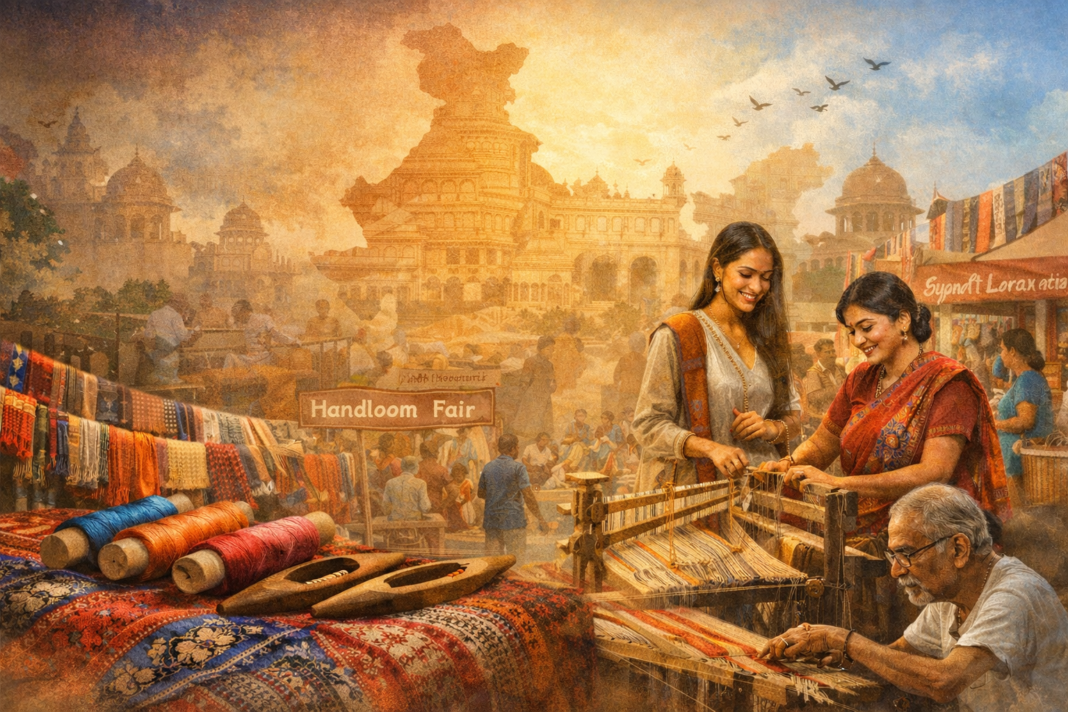
National and regional events celebrating handloom—once attended mainly by specialists—are now attracting urban consumers, designers, students, and influencers. Craft exhibitions are no longer peripheral; they are becoming spaces of cultural exchange. Artisans are not presented merely as beneficiaries of charity, but as skilled producers of value.
This matters because fashion becomes sustainable only when dignity is restored to its makers. Over the last few years, the narrative around artisanship has shifted from “preservation to partnership”, i.e., from saving crafts to wearing them with pride.
A generational recalibration
Today, the young Indian consumers, particularly in urban centres, are approaching fashion differently from their predecessors. They are less interested in accumulation and more interested in meaning. They mix handloom with global silhouettes, pair traditional fabrics with modern cuts, and treat sustainability not as a limitation but as an aesthetic choice.
For them, wearing a handloom is not a political statement—it is a personal one.
The quiet redefinition of aspiration
From the above illustrations and examples, we are witnessing not a rejection of global fashion but a recalibration of aspiration. Indian consumers are no longer asking, “Is this international?” They are asking, “Does this make sense?”
Sense, today, is defined by comfort, climate suitability, longevity, cultural resonance, and increasingly, conscience. This shift does not threaten fashion; it enriches it. Indian handloom is not replacing modern design—it is informing it. Designers are experimenting, consumers are responding, and a more circular, thoughtful fashion ecosystem is slowly taking shape.
Where this leaves us
The handloom revival unfolding across India is not loud, uniform, or complete. It is uneven, urban-skewed, and still vulnerable to market pressures. Nevertheless, it is real. It tells us something important about the Indian consumer: when given choice, dignity, and cultural confidence, they do not choose excess—they choose balance.
The most powerful transformations rarely announce themselves. They unfold quietly—in wardrobes, in habits, in what feels right on the skin. Perhaps that is why this shift matters. It reminds us that sustainability does not always arrive through disruption. Sometimes, it returns through the loom—thread by thread—until fashion feels human again.
Till we meet again….
Dr Prachi Jain
(Disclaimer: The references to public figures and celebrities in this article are made strictly for editorial commentary, cultural analysis, and academic–popular discussion, in line with journalistic fair use and freedom of expression. All observations are derived from publicly available information and appearances. This article does not imply endorsement, commercial association, or consent, nor does it seek to intrude upon personal privacy or violate personality or publicity rights, as recognised under applicable laws, including Article 19(1)(a) of the Constitution of India.)