



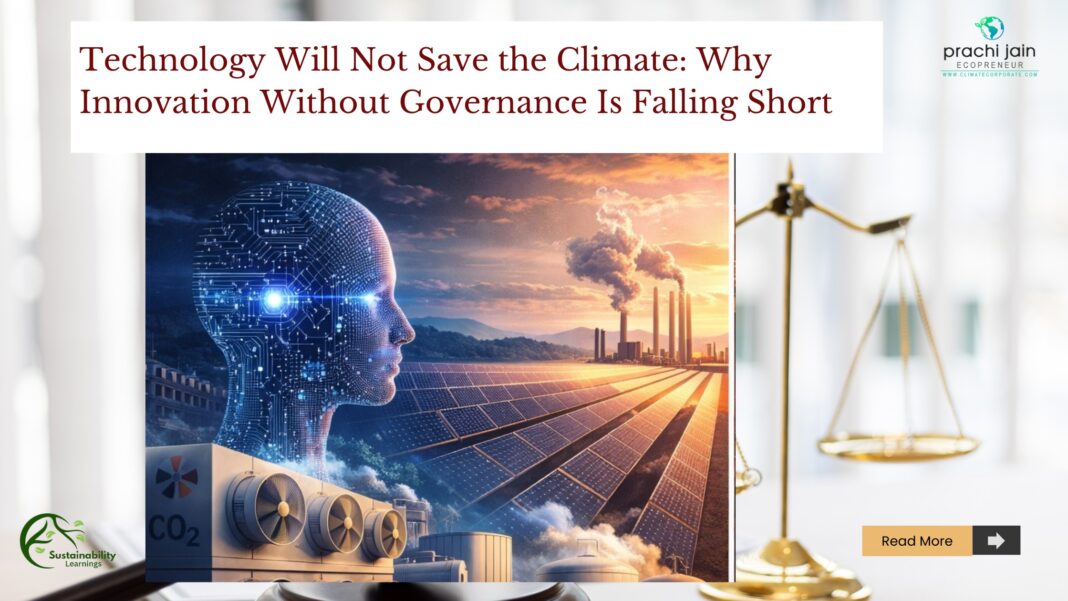
Technology has become the most comfortable answer to the climate crisis. Faced with the scale and complexity of climate change, governments, markets, and societies increasingly turn to innovation for reassurance. From artificial intelligence and clean energy breakthroughs to carbon capture and climate-smart agriculture, technology is often presented as a neutral force capable of solving problems that politics appears unable to address. Yet, this faith in technological solutions masks a deeper, more troubling reality: innovation without governance is proving insufficient—and at times counterproductive.
This is not an argument against technology. Clean energy systems, digital monitoring tools, and efficiency-enhancing innovations are indispensable to any credible climate response. But technology does not operate in a vacuum. Incentives, regulation, access, and power shape it. When governance lags behind innovation, solutions risk reinforcing inequality, delaying structural reform, or creating new forms of environmental and social harm. Climate change, in this sense, is exposing not a failure of innovation but a failure to govern it.
The pace of technological development in climate-related fields has been remarkable. Renewable energy costs have fallen dramatically over the past decade, making solar and wind among the cheapest sources of new electricity generation in many regions. According to the International Energy Agency, global renewable capacity additions reached record levels in recent years, driven by the rapid deployment of solar photovoltaics. Digital technologies now enable real-time tracking of emissions, deforestation, and energy use at scales unimaginable a generation ago. These advances matter. They demonstrate that technological constraints are not the primary barrier to climate action.
Nevertheless, emissions continue to rise. The United Nations Environment Programme has repeatedly warned that current national commitments are insufficient to meet the agreed-upon temperature goals. This disconnect between technological capability and climate outcomes points to a governance gap. Innovation has outpaced the institutions designed to steer it toward public interest outcomes.
Carbon markets offer a telling example. Market-based mechanisms were conceived as cost-effective tools to reduce emissions by assigning a price to carbon. In practice, voluntary carbon markets have grown rapidly, fuelled by corporate net-zero pledges and offsetting strategies. However, concerns over additionality, permanence, and verification have undermined confidence in many offset projects. Investigations into low-quality credits and misleading claims have revealed how weak governance can turn ostensibly climate-positive tools into vehicles for delay and greenwashing.
Carbon capture and storage illustrates a similar tension. While the technology has the potential to play a role in hard-to-abate sectors, its deployment remains limited and expensive. Yet it is frequently invoked to justify continued fossil fuel extraction. Without robust regulatory frameworks and clear boundaries, technological promise risks becoming a political shield rather than a climate solution.
Digitalisation introduces another layer of complexity. Artificial intelligence, satellite monitoring, and data analytics are increasingly used to measure and manage climate risk. These tools can enhance transparency and accountability, but they also raise questions about data ownership, access, and power asymmetries. Climate data concentrated in the hands of a few actors—corporate or governmental—can shape decision-making in ways that exclude vulnerable communities. Technology, when unevenly governed, can amplify rather than reduce existing inequities.
The governance gap is particularly evident in the Global South. Many climate technologies are developed, financed, and controlled by actors in the Global North, while their impacts are felt most acutely elsewhere. Access to clean technologies remains uneven, constrained by cost, intellectual property regimes, and infrastructure limitations—the promise of innovation rings hollow in the absence of institutional capacity and financing.
India’s experience reflects these dynamics. The country has made significant strides in renewable energy deployment, positioning itself as a global leader in solar capacity growth. At the same time, challenges persist in grid integration, storage, and equitable access. Digital governance initiatives have improved monitoring and service delivery, yet disparities in technological access remain pronounced. Technology alone cannot resolve these structural challenges; it must be embedded within coherent policy frameworks.
Climate-smart agriculture offers another illustration. Precision farming tools, drought-resistant seeds, and digital advisory services can enhance resilience, but their benefits are unevenly distributed. Smallholder farmers often lack access to these technologies or the resources needed to use them effectively. Without supportive governance—such as extension services, credit access, and risk-sharing mechanisms—technological solutions risk deepening rural inequality.
Even well-intentioned innovation can have unintended consequences. Large-scale renewable energy projects, for example, may displace communities or disrupt ecosystems if poorly sited. Electric vehicle adoption reduces tailpipe emissions but raises questions about mineral extraction, supply chain ethics, and waste management. Each technological advance introduces new governance challenges that cannot be addressed solely through innovation.
The allure of technological optimism is understandable. It offers a narrative of progress without sacrifice, solutions without political conflict. However, climate change is not merely a technical problem; it is a political, economic, and social one. Technology can change what is possible, but governance determines what is chosen.
This distinction matters because reliance on innovation without reform risks delaying necessary systemic change. When future technologies are treated as substitutes for present action, emissions reductions are postponed, and accountability is diluted. Climate change, however, operates on cumulative timelines. Delays today impose costs tomorrow that no technology can fully reverse.
International climate governance has begun to recognise this tension. Discussions around technology transfer, capacity building, and just transitions reflect an awareness that innovation must be governed to ensure equitable outcomes. Nevertheless, progress remains slow, hampered by geopolitical rivalry, fragmented institutions, and competing economic interests.
The private sector plays a central role in this landscape. Corporations drive much of the innovation in clean technology and digital systems. At the same time, profit incentives do not always align with climate or social objectives. Governance frameworks—through regulation, disclosure requirements, and liability regimes—are essential to align private innovation with public goals. Voluntary commitments, while useful, are insufficient substitutes for enforceable standards.
Ultimately, the question is not whether technology can contribute to climate solutions, but whether societies can govern it effectively. This requires institutions capable of anticipating risks, setting boundaries, and correcting course. It demands transparency, accountability, and participation in decision-making processes that shape technological deployment.
Climate change is revealing the limits of a model that treats innovation as an end in itself. Without governance, technology risks becoming another arena where responsibility is deferred and power concentrated. With governance, it can become a tool for collective resilience.
As the climate crisis accelerates, the temptation to search for technological salvation will only grow. Therefore, the defining challenge of this moment lies elsewhere. It lies in building governance systems that can steer innovation toward outcomes that are not only efficient, but just and sustainable.