



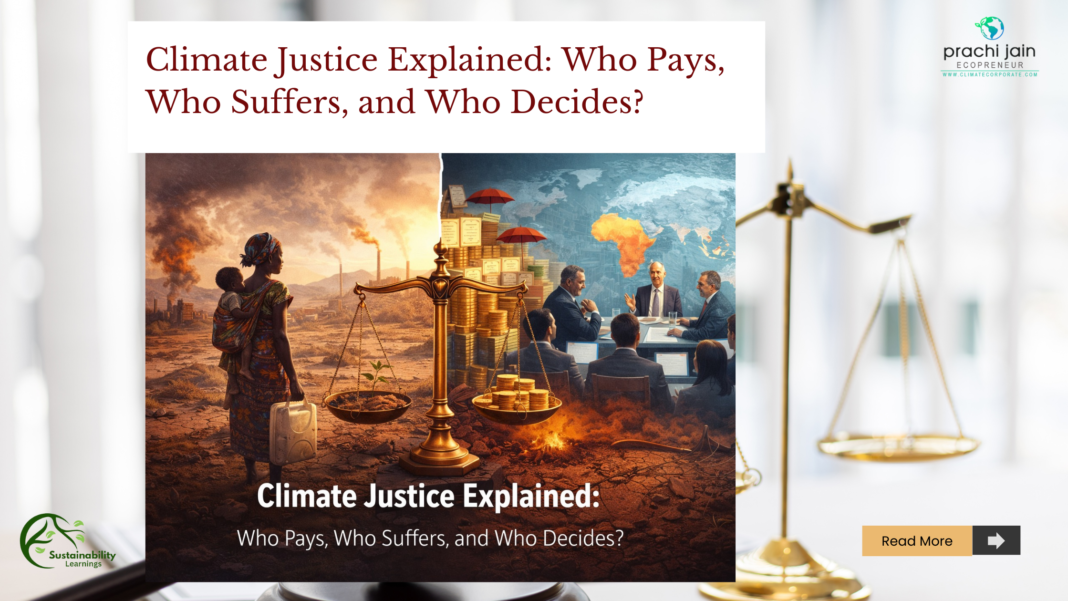
Climate change is often framed as a technical problem—measured in degrees, emissions, and timelines. But for those living with its consequences, it is fundamentally a question of justice. Who bears the cost of a crisis they did little to create? Who is protected, and who is exposed? Moreover, who ultimately decides how the burdens and benefits of climate action are distributed?
These questions sit at the heart of climate justice, a concept that has moved from the margins of academic debate to the centre of global climate governance. As climate impacts intensify, justice is no longer an abstract moral concern; it is a practical test of whether climate policy can command legitimacy, deliver equity, and sustain public trust.
The scientific foundation of the climate crisis is well established. According to the Intergovernmental Panel on Climate Change, global temperatures have already risen by approximately 1.1°C above pre-industrial levels, driving more frequent and severe extreme events. Nevertheless, the distribution of responsibility for this warming is profoundly unequal. High-income countries have contributed the majority of historical emissions, while low- and middle-income countries face the gravest impacts. Climate justice begins with acknowledging this asymmetry.
The consequences of this imbalance are visible across sectors and regions. Communities with the least resources often live in the most climate-vulnerable locations—coastal zones, floodplains, arid regions, and informal urban settlements. They are more exposed to heat stress, food insecurity, water scarcity, and displacement, yet have fewer means to adapt. Climate change, in this sense, operates as a threat multiplier, intensifying existing social and economic inequalities.
Economic data reinforces this reality. The World Bank estimates that climate change could push over 130 million people into extreme poverty by 2030, primarily through impacts on agriculture, health, and livelihoods. These figures are not merely projections; they reflect patterns already unfolding in regions where climate shocks intersect with fragile governance and limited social protection.
Climate justice also challenges conventional approaches to climate mitigation. Policies that focus narrowly on emissions reduction without considering social impacts risk creating new injustices. Carbon pricing mechanisms, for example, can disproportionately affect low-income households if costs are passed on through energy and food prices without adequate compensation. Justice-oriented climate policy demands that mitigation measures be designed alongside safeguards for vulnerable populations.
At the international level, these tensions are most visible in debates over finance and responsibility. Developing countries have long argued that those who contributed most to the problem should bear a greater share of the solution. This principle is reflected in the concept of common but differentiated responsibilities, embedded in international climate agreements. Nevertheless, the gap between commitments and delivery remains wide. Climate finance flows have consistently fallen short of pledged targets, undermining trust and slowing collective action.
The issue of loss and damage brings the justice dimension into sharp relief. Some climate impacts cannot be adapted to or reversed—entire ecosystems are lost, livelihoods destroyed, and cultural heritage erased. Recognising and compensating for such irreversible losses has emerged as a central demand from climate-vulnerable countries. Recent international discussions signal progress, but operationalising loss and damage finance remains politically contentious and institutionally complex.
India’s position illustrates the layered nature of climate justice. As a country with low per capita emissions but high vulnerability, India occupies a dual role in the climate justice debate. Millions depend on climate-sensitive sectors such as agriculture and fisheries, while rapid development remains a priority. Climate justice in this context is not about avoiding responsibility, but about ensuring that development pathways remain equitable and resilient.
Domestically, climate justice intersects with questions of livelihood security, energy access, and urban inequality. Heatwaves disproportionately affect outdoor workers, water scarcity burdens women and marginalised communities, and climate-induced migration strains social systems. Addressing these challenges requires policies that integrate climate goals with social justice objectives rather than treating them as competing priorities.
Intergenerational justice adds another layer to the debate. Decisions made today will shape the climate risks faced by future generations, who have no voice in current policy processes. The accumulation of emissions, the depletion of natural resources, and the delay in climate action transfer burdens forward in time. This raises ethical questions about representation, responsibility, and stewardship that traditional governance frameworks are ill-equipped to address.
Legal systems are increasingly being called upon to navigate these tensions. Courts in multiple jurisdictions have recognised the rights of present and future generations to a healthy environment, compelling governments to strengthen climate action. These cases do not resolve all questions of justice, but they signal a growing willingness to translate ethical claims into enforceable obligations.
Markets, too, are being drawn into the justice conversation. Investors are beginning to assess not only climate risk, but social risk—recognising that projects that disregard community impacts face higher long-term liabilities. However, market mechanisms alone cannot ensure justice. Without clear rules and accountability, financial flows may continue to favour those already advantaged.
Technology, often touted as a neutral solution, reflects similar dynamics. Access to clean energy, climate-resilient infrastructure, and adaptive technologies remains uneven without deliberate efforts to ensure affordability and inclusion; innovation risks reinforcing existing divides. Climate justice demands that technological transitions be managed in ways that expand opportunity rather than entrench exclusion.
The governance challenge, therefore, is not simply to reduce emissions or deploy new technologies, but to design systems that allocate responsibility fairly and protect those most at risk. This requires coordination across levels of government, sectors, and borders—an undertaking that tests the limits of current institutions.
Climate justice also reshapes how success is measured. Progress cannot be assessed solely through aggregate emissions reductions or economic indicators. It must be evaluated through outcomes that matter to people: reduced vulnerability, improved access to resources, and greater resilience for those historically marginalised. Without this shift, climate policy risks losing legitimacy even as it advances technically.
As the impacts of climate change accelerate, justice will increasingly determine the politics of climate action. Policies perceived as unfair will face resistance, while those grounded in equity are more likely to endure. Climate justice, in this sense, is not an obstacle to effective climate action—it is a prerequisite for it.
The climate crisis forces societies to confront uncomfortable truths about power, responsibility, and inequality. It asks whether governance systems can rise to the challenge of distributing burdens and benefits in a way that is not only efficient, but fair. The answer to this question will shape not just climate outcomes, but the broader social contract of the twenty-first century.
Climate justice is not a slogan, nor a peripheral concern. It is the lens through which all climate action must now be evaluated. Who pays, who suffers, and who decides are no longer theoretical questions. They are the defining tests of whether humanity can respond to climate change with integrity, foresight, and solidarity.