



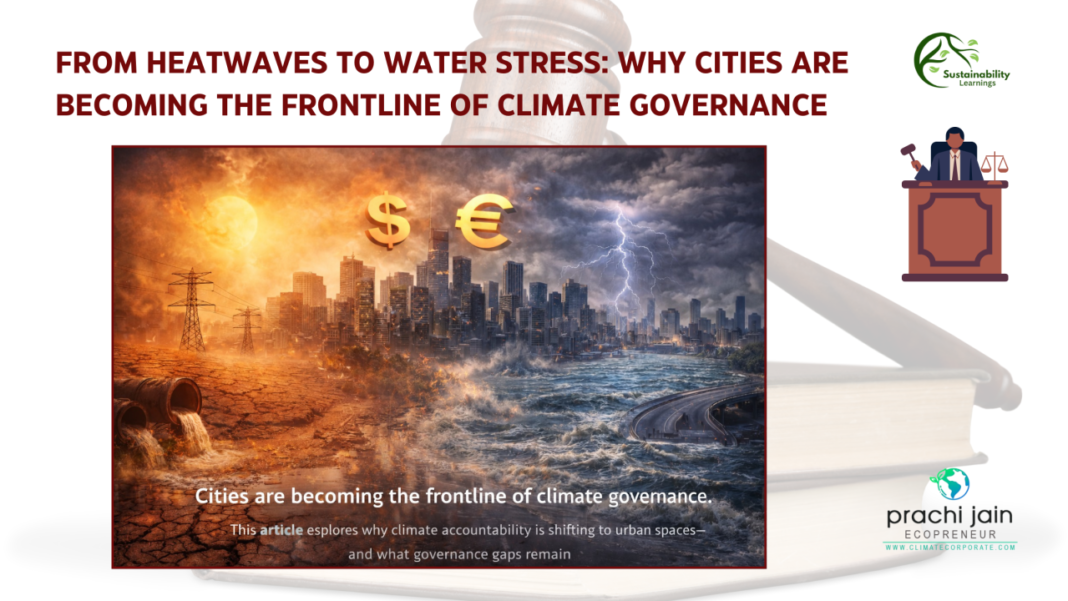
Climate change does not arrive as an abstract global average. It arrives as heat trapped between concrete buildings, as water taps running dry, as flooded streets that halt daily life, and as infrastructure pushed beyond its limits. Increasingly, these impacts are concentrated not in remote ecosystems or distant projections, but in cities—where more than half of the world’s population now lives.
This is why the climate crisis is rapidly becoming an urban governance crisis. While international negotiations and national policies continue to shape climate ambition, cities are confronting the consequences of climate change in real time. From heatwaves and water stress to flooding, housing precarity, and public health emergencies, urban centres have become the frontline where climate risk meets everyday governance.
The scale of the challenge is immense. According to the United Nations, nearly 70% of the global population is expected to live in urban areas by 2050, intensifying pressure on infrastructure, resources, and governance systems. At the same time, cities account for over 70% of global carbon dioxide emissions, making them both contributors to—and victims of—the climate crisis. This dual role places cities at the centre of climate accountability, even as they often operate with limited authority and constrained resources.
Climate science underscores the urgency of this urban dimension. The Intergovernmental Panel on Climate Change has warned that cities are particularly vulnerable to compound climate risks, where heat, flooding, air pollution, and social inequality interact to magnify harm (IPCC AR6, 2023). Extreme heat events are becoming longer, more frequent, and more intense, with urban heat island effects amplifying temperatures by several degrees compared to surrounding areas. For millions of urban residents, this is no longer a seasonal inconvenience—it is a public health threat.
The human cost of urban heat is already visible. Europe’s 2022 heatwave resulted in an estimated 61,000 excess deaths, according to peer-reviewed research published in Nature Medicine. In India, recurring heatwaves have disrupted labour productivity, strained health systems, and exposed the limits of urban preparedness. The World Bank estimates that by 2030, heat stress could reduce working hours in India by the equivalent of 34 million full-time jobs, with urban informal workers particularly affected.
Water stress presents an equally stark picture. Cities across continents are grappling with declining groundwater levels, erratic rainfall, and ageing water infrastructure. Cape Town’s narrowly averted “Day Zero” crisis, Chennai’s water shortages, and Mexico City’s sinking aquifers illustrate a broader pattern: urban water systems designed for historical climate conditions are failing under new climatic realities. According to the World Resources Institute, nearly one-quarter of the world’s urban population lives in water-stressed regions, a figure expected to rise sharply.
Flooding adds another layer of vulnerability. Urban flooding, driven by intense rainfall, poor drainage, and unchecked development, has become a recurring feature in cities from Mumbai and Jakarta to Houston and Lagos. The World Bank estimates that urban flooding causes billions of dollars in damage each year, disproportionately affecting low-income communities living in informal settlements or in flood-prone areas. These impacts are not random; they reflect long-standing governance failures in land use planning, housing policy, and infrastructure investment.
Faced with these pressures, cities are increasingly being forced to act—often faster than national governments. Heat action plans, climate-resilient infrastructure projects, early warning systems, and nature-based solutions are being piloted at the city level, sometimes in the absence of coherent national frameworks. Ahmedabad’s Heat Action Plan, one of the first of its kind in South Asia, has been credited with reducing heat-related mortality through early warnings, public awareness, and coordinated response mechanisms. Similar initiatives have since been replicated across Indian cities, demonstrating how local governance can translate climate science into lifesaving action.
Globally, cities are also emerging as laboratories of climate innovation. Urban climate networks such as C40 Cities and ICLEI facilitate knowledge sharing, policy experimentation, and collective action, often filling gaps left by slow-moving national processes. These networks reflect a broader shift in climate governance: authority is becoming more distributed, and cities are asserting themselves as critical actors rather than passive implementers.
Nevertheless, this urban leadership comes with significant constraints. Cities are responsible for managing climate impacts, but they often lack the fiscal autonomy, legal authority, and long-term financing required to implement transformative solutions. According to the OECD, cities account for the majority of climate-relevant public investment, yet they receive only a fraction of climate finance flows. This mismatch between responsibility and resources exposes a fundamental flaw in the current climate governance architecture.
The challenge is particularly acute in the Global South, where rapid urbanisation intersects with limited institutional capacity. Informal settlements, inadequate housing, and unequal access to services magnify climate vulnerability, turning environmental shocks into social crises. Climate change, in this context, is not only an environmental threat but a stress test for urban governance systems already under strain.
India’s urban transition exemplifies these tensions. As the country urbanises at an unprecedented pace, its cities face mounting climate risks alongside development imperatives. Floods in Mumbai, water shortages in Bengaluru, and heatwaves across northern India reveal how climate stress interacts with planning deficits and infrastructure gaps. While national initiatives such as the Smart Cities Mission have sought to modernise urban governance, critics argue that climate resilience has not been sufficiently integrated into urban development priorities.
This disconnect raises a deeper question: who governs climate risk in cities? Municipal authorities are often the first responders to climate impacts, yet their ability to act is shaped by state and national policies, financial transfers, and regulatory frameworks. When these higher-level systems fail to align, cities are left to manage the consequences without the tools to prevent them.
Despite these challenges, the urban turn in climate governance offers important lessons. Cities demonstrate that climate action need not wait for global consensus. They show how targeted interventions—when grounded in local realities—can deliver tangible benefits. At the same time, urban climate governance exposes the limits of decentralised action. Without supportive national frameworks and equitable financing, local innovation risks remaining fragmented and insufficient.
The growing prominence of cities in climate governance also reshapes questions of accountability. When climate impacts are felt most acutely at the urban level, residents increasingly hold local authorities responsible—even when the causes lie beyond municipal control. This tension underscores the need for clearer allocation of responsibility across governance levels, ensuring that cities are empowered rather than overburdened.
As climate change accelerates, cities will remain where its consequences are most visible and contested. Urban governance will shape who is protected, who is exposed, and whose voices are heard in climate decision-making. In this sense, cities are not just sites of vulnerability; they are arenas where the future of climate governance is being negotiated daily.
The defining challenge ahead is not whether cities can act, but whether governance systems can support them. Climate resilience in cities requires more than local innovation—it demands coordinated policy, sustained investment, and institutional reform across levels of government. Without this alignment, urban climate action will remain reactive, addressing symptoms rather than causes.
If earlier phases of climate governance were dominated by diplomacy and litigation, the current phase is increasingly urban. The climate crisis is being lived block by block, neighbourhood by neighbourhood, city by city. How well cities are governed in this moment will determine not only their resilience but the broader trajectory of climate justice and sustainability.
Cities did not choose to become the frontline of climate governance. Nevertheless, as climate impacts intensify and political systems struggle to keep pace, they have become its most immediate testing ground. Whether this leads to more resilient, equitable urban futures—or deeper fragmentation—will depend on how governance evolves to meet the realities unfolding on the ground.
Bibliography / Sources
- Intergovernmental Panel on Climate Change (IPCC). AR6 Synthesis Report, 2023.
- United Nations Department of Economic and Social Affairs (UN DESA). World Urbanization Prospects, 2022.
- World Health Organization (WHO). Heat and Health Reports.
- Nature Medicine. Excess Mortality from the 2022 European Heatwaves, 2023.
- World Bank. Climate Change, Urban Development, and Resilience Reports.
- World Resources Institute (WRI). Aqueduct Water Risk Atlas.
- OECD. Financing Climate-Resilient Cities.
- C40 Cities Climate Leadership Group. Urban Climate Action Reports.
- Government of India. National Disaster Management Authority – Heat Action Plans.