



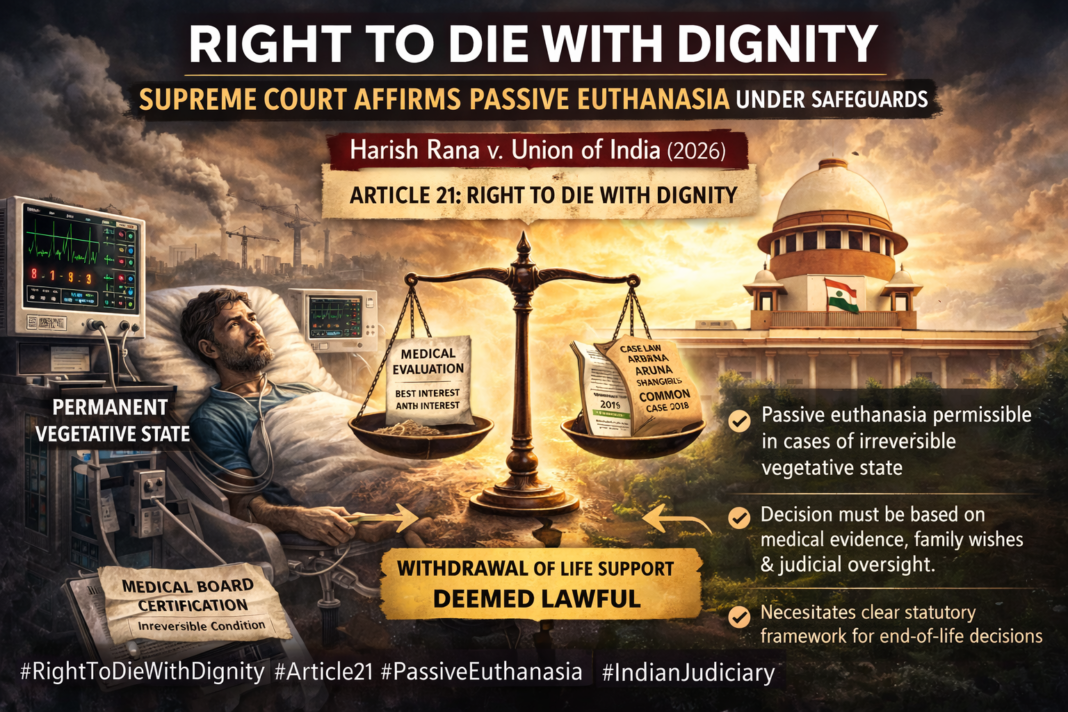
The Supreme Court, in the Harish Rana case (2026), has revisited the scope of Article 21 of the Constitution in the context of withdrawal of life-sustaining treatment, reaffirming the legal position that the right to life includes the right to die with dignity, subject to strict procedural safeguards.
The case concerned a patient who had remained in a permanent vegetative state for several years following a severe accident and was surviving only through artificial life support, with medical boards repeatedly certifying the absence of any possibility of recovery. Upon considering the reports of the medical experts, the wishes expressed by the family, and the existing legal framework governing passive euthanasia, the Court permitted withdrawal of life-sustaining treatment, holding that continuation of invasive medical support in such circumstances would not advance the purpose of Article 21, which protects life with dignity and not mere biological existence.
The Court relied on the principles laid down in Aruna Ramchandra Shanbaug v. Union of India (2011) and Common Cause v. Union of India (2018), in which passive euthanasia and the validity of living wills were recognised. It reiterated that withdrawal of treatment in cases of irreversible vegetative state is legally permissible when the decision is taken in accordance with the procedure prescribed by the Court, including evaluation by a duly constituted medical board and oversight by the High Court.
Importantly, the Court clarified that passive euthanasia does not amount to causing death, but only allows the natural process of death to take place where medical intervention merely prolongs the dying process without any prospect of recovery. The judgment further emphasised the need for a clear statutory framework to regulate end-of-life decisions, noting that repeated recourse to judicial orders indicates the necessity of legislative intervention.
The ruling strengthens the existing jurisprudence that Article 21 protects dignity throughout the course of life, including at the stage where medical treatment ceases to serve any therapeutic purpose, and confirms that the legality of withdrawal of life support must be assessed based on medical evidence, procedural safeguards, and the best-interest standard evolved by the Court.