



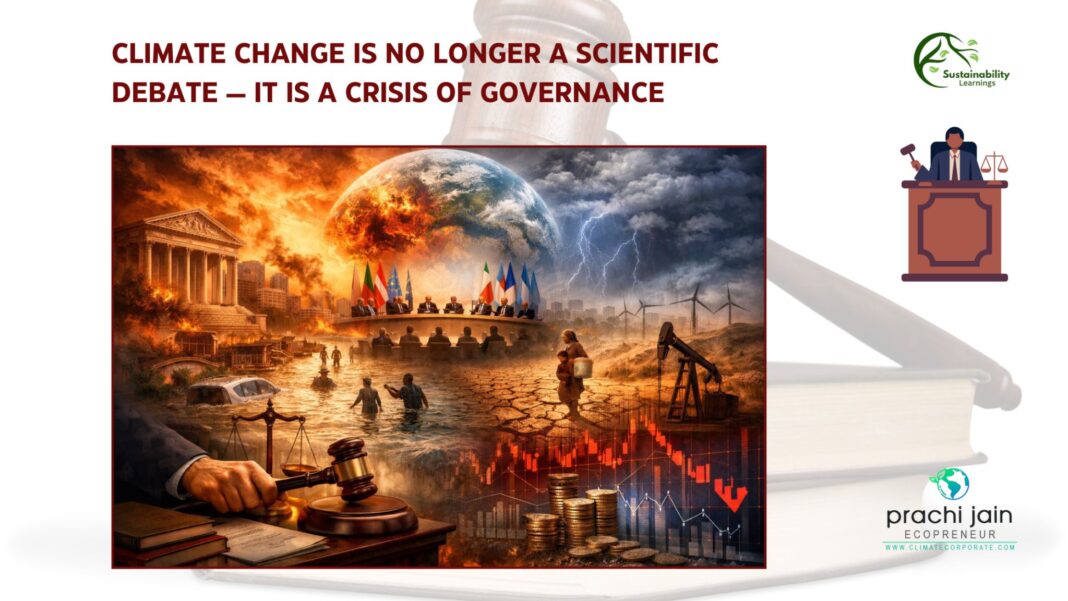
For much of the late twentieth century, climate change was treated as a problem of uncertainty. Policymakers asked for more data, sceptics demanded more proof, and institutions deferred action in the name of further research; that phase has decisively ended. Today, climate science is not only settled but also overwhelming in its consistency and urgency. What remains unresolved is not the what or the why of climate change, but the how of responding to it.
Climate change has moved beyond the laboratory and into courtrooms, boardrooms, city councils, insurance markets, and households. It has become a stress test for governance itself — exposing the limitations of political systems, regulatory frameworks, and institutional coordination that were never designed for a rapidly warming world. The real crisis we face today is therefore not scientific. It is a governance crisis.
The scientific consensus is explicit. According to the Intergovernmental Panel on Climate Change (IPCC), the Earth has already warmed by approximately 1.2°C above pre-industrial levels, with the remaining carbon budget for limiting warming to 1.5°C rapidly shrinking (IPCC AR6 Synthesis Report, 2023). The World Meteorological Organisation confirmed that 2023 was the hottest year on record, with multiple months temporarily breaching the 1.5°C threshold (WMO, 2024). At the same time, global greenhouse gas emissions reached a record 57.4 gigatonnes of CO₂-equivalent, despite decades of climate negotiations (UNEP Emissions Gap Report, 2024).
These figures are not new revelations. What is new is the growing recognition that political and administrative systems are structurally incapable of translating knowledge into action at the required scale and speed. Climate change is no longer a problem of awareness; it is a problem of institutional capacity and political will.
This failure was laid bare by the Global Stocktake under the Paris Agreement, concluded in the mid-2020s. The Stocktake revealed that no major economy is currently on track to meet its climate commitments, and that existing national policies place the world on a trajectory of 2.5–2.9°C of warming by the end of the century (UNFCCC Global Stocktake, 2023; Climate Action Tracker, 2024). Even as governments reaffirmed their commitments, fossil fuel subsidies surged to an unprecedented USD 1.7 trillion in 2023, effectively undercutting climate goals through public finance (International Energy Agency, 2024). In practical terms, this means governments are promising long-term action while financing short-term damage.
This contradiction, i.e., ambitious targets coexisting with contradictory policy choices, lies at the heart of the governance crisis. Climate change demands long-term, coordinated decision-making, yet political systems are structured around short electoral cycles, fragmented jurisdictions, and sector-specific silos. The result is inertia disguised as process.
As governments delayed action, courts increasingly became the forum for demanding climate accountability. When executive action faltered, courts worldwide filled the vacuum. Climate litigation has emerged as one of the most significant governance developments of the past decade. In Urgenda Foundation v. State of the Netherlands (2019), the Dutch Supreme Court held that insufficient climate action violated the government’s duty of care and fundamental human rights, compelling legally binding emission reductions. Germany’s Federal Constitutional Court followed suit in 2021, ruling that inadequate climate legislation unfairly shifted the burden of emissions reduction onto future generations, thereby infringing constitutional protections.
Similar judicial interventions have occurred beyond Europe. Brazil’s Supreme Federal Court, in the ADPF 708 (2022) case, recognised the Paris Agreement as a human rights instrument and held the government accountable for failing to operationalise its Climate Fund. In the United States, the Montana youth climate case (Held v. State of Montana, 2023) marked the first successful constitutional climate challenge, affirming the right to a “clean and healthful environment.” These cases differ in legal context but share a common message: when political systems fail to protect citizens from foreseeable climate harm, courts are willing to intervene.
Nevertheless, while markets quantify climate risk, people experience it in daily life. In parallel with judicial action, financial markets are responding with speed and clarity that political institutions often lack. Climate change has become a material financial risk. According to the World Bank, climate-related disasters have caused over USD 1.3 trillion in economic losses globally over the past decade, with uninsured losses rising sharply. Insurance markets have begun withdrawing coverage from climate-vulnerable regions in California, Florida, and parts of Australia, effectively signalling that certain risks are no longer economically viable.
Regulators are taking note, too. Central banks and financial supervisors, through networks such as the Network for Greening the Financial System (NGFS), have begun integrating climate stress tests into prudential regulation. The European Union has moved toward mandatory climate risk disclosure through the Corporate Sustainability Reporting Directive (CSRD). At the same time, global carbon pricing mechanisms now cover approximately 23% of global emissions, generating over USD 100 billion annually (World Bank Carbon Pricing Dashboard, 2024). In contrast to political commitments, markets respond immediately to risk — repricing assets, reallocating capital, and reshaping incentives.
Beyond this, governance failures extend beyond law and finance into the physical systems that sustain daily life. Climate change is increasingly manifesting as infrastructure breakdown. Heatwaves have strained electricity grids across India, Europe, and North America. Pakistan’s catastrophic floods in 2022 displaced millions and caused infrastructure damage exceeding USD 30 billion, overwhelming state capacity. Europe’s 2023 heatwave led to railway distortions, airport runway damage, and an estimated 60,000 excess heat-related deaths (Nature Medicine, 2023). Water systems in cities such as Chennai, Cape Town, and Mexico City have repeatedly approached “Day Zero” conditions, underscoring the fragility of urban governance in a warming climate.
These failures are not isolated incidents. They reflect systemic misalignment between climate risks and governance design. Climate impacts cut across sectors — energy, water, health, housing, agriculture, transport — yet decision-making remains fragmented across ministries and agencies. Laws exist, but enforcement is inconsistent. Budgets are announced, but underutilised. Adaptation plans are drafted, but rarely operationalised. Climate change exposes not slow governance, but misconfigured governance.
The consequences of this misalignment are felt most acutely in the Global South. Developing countries contribute a disproportionately small share of historical emissions — less than 14% — yet bear the brunt of climate impacts (UNFCCC). The United Nations estimates that loss and damage costs could reach USD 290–580 billion annually by 2030, while the World Bank projects that 216 million people could become internal climate migrants by 2050. Climate change thus magnifies existing inequalities, turning governance failure into a question of justice.
Despite these challenges, new forms of climate governance are emerging. Courts are reframing climate action as a rights-based obligation. Financial regulators are embedding climate risk into the architecture of markets. Cities are adopting heat action plans, resilience strategies, and low-emission transport systems, often moving faster than national governments. Corporations, under pressure from investors and regulators, are shifting from voluntary climate commitments to compliance-driven transition planning. These developments point to a decentralised, polycentric model of governance — one that operates beyond traditional treaty-based frameworks.
Understanding climate change through a systems lens is therefore essential. Climate change is not a single environmental problem with a single solution; it is a multi-system disruption that challenges the foundations of law, economics, governance, and social organisation. It reveals the limits of institutions designed for stability in an era defined by volatility.
The question before us is no longer whether climate change is real or whether action is needed. The question is whether societies can adapt their governance structures quickly enough to manage a transformation of this magnitude. Climate change will continue to reshape the world; the only uncertainty is whether governance will evolve in time, or whether failure will deepen the crisis it seeks to manage.
The scientific debate is settled. What remains uncertain is whether governance can evolve quickly enough to meet a crisis that does not wait for consensus or convenience. Climate change will continue to reshape the world. The defining question of this century is whether governance reshapes itself in time.