



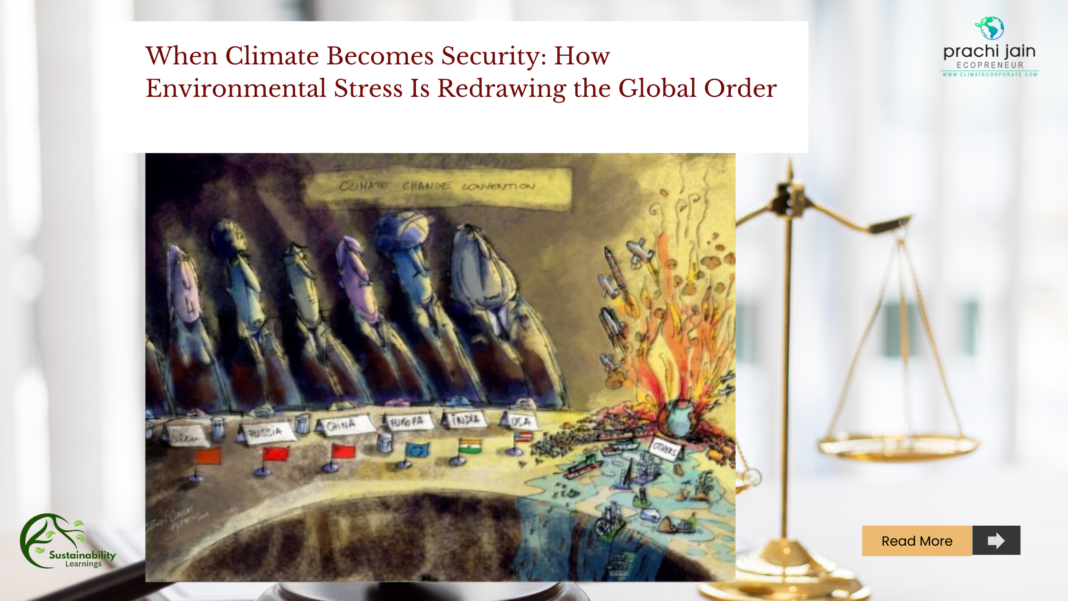
Climate change has long been framed as an environmental issue, occasionally an economic one, and increasingly a moral one. It is now something more unsettling: a matter of national and global security. As temperatures rise and weather patterns destabilise, climate stress is no longer confined to ecosystems. It is reshaping strategic calculations, redrawing geopolitical maps, and forcing governments to rethink the foundations of stability.
This shift is not rhetorical. Defence establishments across the world now formally recognise climate change as a threat multiplier. The United States Department of Defence has repeatedly identified climate impacts as drivers of instability, capable of exacerbating conflict, disrupting supply chains, and straining military infrastructure. Similar assessments have emerged from NATO and the European Union, which acknowledge that climate stress intersects with migration, resource scarcity, and political fragility. Climate change, in this framing, does not create conflict in isolation—but it intensifies underlying vulnerabilities in ways that challenge traditional security paradigms.
The scientific backdrop to this reassessment is stark. According to the Intergovernmental Panel on Climate Change, extreme weather events are becoming more frequent and severe, sea levels are rising at accelerating rates, and water systems are undergoing profound shifts. These changes are not distributed evenly. Regions already facing governance challenges, economic inequality, or resource dependence are particularly exposed. In such contexts, environmental stress can undermine food systems, reduce economic opportunity, and weaken state capacity, creating conditions in which unrest or instability becomes more likely.
Water scarcity illustrates the security implications of climate stress. Major transboundary river systems—the Nile, the Indus, the Mekong—are increasingly subject to pressures from altered rainfall patterns, glacial retreat, and rising demand. The World Bank has warned that water scarcity exacerbated by climate change could reduce regional GDP in some areas by up to 6% by mid-century. When water becomes uncertain, agriculture suffers, urban tensions rise, and diplomatic relations strain. Water disputes are rarely caused solely by climate change, but climate variability can intensify competition in already fragile arrangements.
Food security is similarly intertwined with stability. The Food and Agriculture Organisation reports that climate-related shocks have contributed to rising global hunger, with hundreds of millions of people facing food insecurity. Sudden spikes in food prices have historically been associated with political unrest. When harvests fail due to drought or flood, the consequences ripple through markets and governance systems. Climate stress thus becomes embedded within national security calculations, not because it replaces traditional threats, but because it interacts with them.
Sea-level rise introduces another strategic dimension. Low-lying coastal regions, including densely populated megacities and critical infrastructure hubs, are increasingly exposed. The displacement of populations from vulnerable coastlines is not only a humanitarian issue; it has implications for urban planning, economic productivity, and social cohesion. For small island states, rising seas raise existential questions about sovereignty and territorial integrity. Climate change challenges the stability of borders and the very meaning of statehood.
The Arctic provides perhaps the most visible example of climate reshaping geopolitics. As warming accelerates in the polar region—at rates exceeding the global average—new shipping routes and resource opportunities are emerging. Nations are recalibrating strategic interests in response to melting ice and shifting access. What was once a frozen frontier is becoming a theatre of geopolitical competition. Climate change is not merely an environmental process here; it is a catalyst for strategic repositioning.
India’s security landscape reflects many of these global dynamics. As a country deeply dependent on monsoon stability and shared river systems, India faces complex intersections between climate stress and regional geopolitics. Variability in glacial melt in the Himalayas affects river flows across national boundaries, while increasing frequency of extreme weather events places pressure on disaster response systems and infrastructure. The Indian Armed Forces have acknowledged climate-related challenges, including the need to adapt infrastructure and logistics to more volatile conditions.
Internal security is equally affected. Climate-induced distress migration, water scarcity in urban centres, and heatwaves affecting labour productivity all carry implications for governance stability. These stresses do not manifest as traditional military threats, yet they influence economic resilience and social order—foundations upon which national security ultimately rests.
Insurance and financial systems are also incorporating climate risk into security assessments. When regions become increasingly uninsurable due to repeated climate disasters, economic retreat can follow. Property markets, investment flows, and infrastructure financing respond to perceived instability. Climate risk, therefore, migrates from the environmental sphere into the economic and political domains, reinforcing its security significance.
Nevertheless, securitising climate change carries risks of its own. Framing climate primarily as a security threat may justify restrictive migration policies or militarised responses to humanitarian crises. It can shift focus from mitigation and adaptation toward containment and control. The challenge for policymakers is to recognise the security dimensions of climate stress without allowing security logic to eclipse justice and cooperation.
These tensions increasingly shape international climate diplomacy. The most vulnerable nations argue that security begins with adequate climate finance, adaptation support, and equitable mitigation commitments. Failure to address these demands risks deepening geopolitical mistrust. Climate security, in this context, is inseparable from climate justice.
Technology, too, intersects with security concerns. Critical minerals essential for renewable energy systems—lithium, cobalt, and rare earth elements—are becoming strategically significant. Supply chain concentration in specific regions introduces vulnerabilities that governments are keen to diversify away from. The energy transition thus creates new security dependencies even as it seeks to reduce reliance on fossil fuels.
The convergence of climate and security underscores a broader transformation in governance. Traditional security frameworks were designed around territorial threats and military deterrence. Climate stress operates differently: it is diffuse, cumulative, and transboundary. It demands coordination across ministries—defence, environment, agriculture, water, and finance—rather than siloed responses. Institutional adaptation is therefore as important as technological adaptation.
There is also a generational dimension to climate security. Younger populations will inherit the compounded consequences of delayed action, including increased displacement, resource strain, and economic volatility. Security planning that focuses solely on immediate risks overlooks the long-term destabilisation potential of unchecked warming.
Ultimately, recognising climate change as a security issue is less about alarmism than about realism. Environmental stress is already reshaping economic prospects, migration patterns, and geopolitical calculations. Ignoring these connections does not preserve stability; it obscures emerging risks.
However, the most important insight may be this: climate security cannot be achieved solely through defensive measures. Military preparedness, border controls, and disaster response systems may mitigate symptoms, but they do not address root causes. Reducing emissions, strengthening adaptation, investing in resilience, and fostering international cooperation remain the most effective security strategies in a warming world.
Climate change is not replacing traditional security concerns; it is redefining them. It forces states to confront vulnerabilities that cannot be deterred or negotiated away. In doing so, it challenges long-standing assumptions about power and protection.
The question is no longer whether climate change affects security; it is whether it does. The question is whether governance systems can evolve quickly enough to manage a world in which environmental stress shapes the contours of stability itself. How nations answer this question will determine not only their climate trajectory but their geopolitical future.