



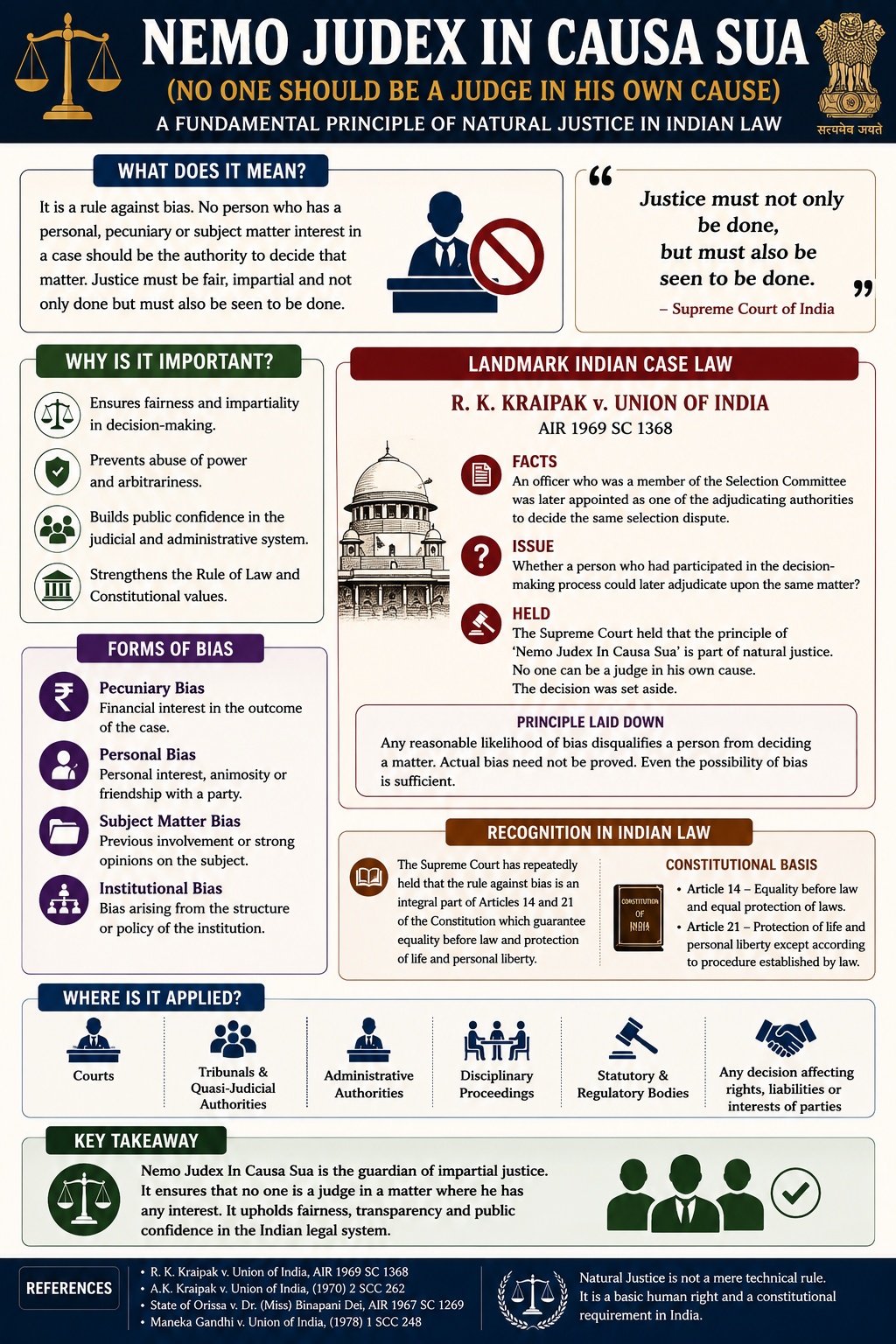
One of the oldest and most powerful principles of law answers with a clear and unequivocal No.:
“Nemo Judex In Causa Sua“, i.e., No One Should Be a Judge in His Own Cause.
This is not merely a Latin maxim; instead, it is the moral and constitutional foundation upon which public trust in the justice system rests. The Supreme Court of India, in A.K. Kraipak v. Union of India, reaffirmed that even the likelihood of bias is sufficient to vitiate a decision. The law does not wait for injustice to occur; it acts to prevent even the possibility of unfairness.
This principle extends beyond courtrooms. It applies to administrative authorities, tribunals, disciplinary committees, regulatory bodies, and every institution entrusted with decision-making power. When a person with a personal, financial, or institutional interest decides a matter, the integrity of the process itself comes into question.
As rightly observed: “Justice must not only be done, but must also be seen to be done.”
In an era where transparency, accountability, and institutional credibility are under constant scrutiny, the rule against bias remains one of the strongest safeguards of democracy and the Rule of Law. Because the legitimacy of every decision begins with one simple question:
Was the decision-maker truly impartial?
⚖️ Natural Justice is not a technical rule. It is the heartbeat of a fair legal system.