



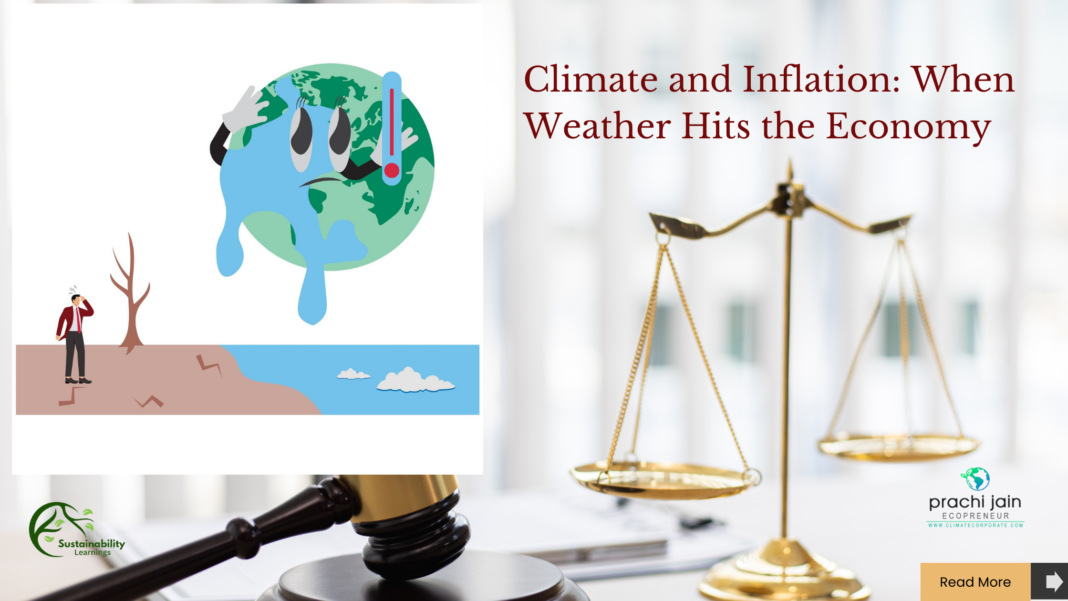
Inflation is often described as a monetary phenomenon. Central banks adjust interest rates. Governments revise fiscal spending. Economists debate liquidity and supply chains. However, increasingly, a quieter force is influencing prices in ways traditional macroeconomic models struggle to capture: climate change.
Extreme weather events are no longer rare disruptions. They are recurring economic shocks. Heatwaves reduce labour productivity. Floods interrupt logistics. Droughts affect crop yields. Storms damage infrastructure. These environmental disturbances ripple through supply chains and markets, eventually appearing in the most visible place of all — consumer prices.
The Intergovernmental Panel on Climate Change has confirmed with high confidence that climate change is intensifying the frequency and severity of extreme weather events across regions. The economic implications are measurable. According to global catastrophe loss data from major reinsurance firms such as Munich Re, annual losses from natural disasters have repeatedly exceeded $100 billion in recent years, with climate-related hazards accounting for the majority of events. These losses are not abstract accounting entries. They represent destroyed assets, disrupted production, and constrained supply.
Food inflation provides one of the clearest illustrations. Agricultural output is inherently climate-sensitive. Drought conditions reduce crop yields; excessive rainfall damages harvests; heat stress lowers livestock productivity. The Food and Agriculture Organisation (FAO) has documented increasing variability in global food production linked to climate extremes. When supply tightens, prices respond.
In India, the relationship between monsoon variability and food prices has long been recognised. Erratic rainfall patterns directly affect staple crops such as rice, wheat, and pulses. Heatwaves in recent years have reduced wheat output, prompting export restrictions to protect the domestic supply. Such measures may temporarily stabilise internal markets, but they also contribute to global price volatility. What begins as a climate shock in one region can quickly become a cross-border economic signal.
Energy markets exhibit similar sensitivity. Extreme weather affects both supply and demand. Heatwaves drive higher electricity consumption for cooling. Cold spells increase heating demand. Storms disrupt power generation and transmission infrastructure. At the same time, water scarcity can affect hydropower generation, while heat stress reduces the efficiency of thermal plants. The International Energy Agency has highlighted how climate variability influences energy security and price stability.
Insurance markets are another channel through which climate risk affects inflation. As climate-related losses rise, insurers adjust premiums to reflect higher risk exposure. In some high-risk regions, coverage becomes prohibitively expensive or unavailable. Rising insurance costs feed into housing expenses, construction costs, and business overheads. Financial vulnerability becomes embedded within price structures.
Labour productivity adds yet another dimension. The International Labour Organisation has estimated that rising temperatures could lead to significant productivity losses, particularly in sectors such as agriculture and construction. Reduced output combined with sustained demand exerts upward pressure on prices. Heat is not merely a health concern; it is an economic variable.
Central banks are increasingly aware of these dynamics. The Network for Greening the Financial System, a coalition of central banks and supervisors, has warned that climate change poses material risks to financial stability and macroeconomic performance. While monetary policy can respond to inflationary pressures, it cannot eliminate climate-induced supply shocks. Rate adjustments cannot restore a harvest destroyed by drought or rebuild infrastructure damaged by floods.
This introduces a structural complication. Traditional inflation frameworks often assume that cyclical disturbances are present. Climate-related inflation, however, may become structural if extreme weather events intensify over time. Persistent supply volatility challenges the assumption that inflation can be neatly contained through conventional tools.
The political implications are significant. Inflation directly affects households. Rising food and energy prices disproportionately impact lower-income groups, intensifying inequality. When climate shocks translate into higher living costs, public frustration can manifest as political instability. Climate policy debates become entangled with affordability concerns, even when the root cause of price volatility lies in environmental disruption.
Developing economies face particular vulnerability. The agricultural sector often employs large segments of the population. Infrastructure resilience may be limited. Fiscal space to subsidise price spikes is constrained. For countries balancing development priorities with climate resilience, inflationary pressures can complicate policy trade-offs.
At the global level, climate-induced inflation may also influence trade dynamics. Export bans, stockpiling behaviour, and supply chain adjustments alter market flows. Financial markets respond to perceived risk. Commodity price volatility affects currency stability in import-dependent nations.
The interplay between climate and inflation underscores a broader insight: environmental stability underpins economic stability. Macroeconomic systems evolved during a period of relative climatic predictability. As environmental volatility increases, economic volatility follows.
Mitigation and adaptation strategies, therefore, carry macroeconomic relevance. Investing in resilient infrastructure, diversified energy systems, climate-smart agriculture, and early warning mechanisms can dampen the inflationary impact of climate shocks. Prevention is not only environmentally prudent; it is economically stabilising.
India’s expanding renewable capacity, for instance, contributes not only to emissions reduction but to diversification of energy supply, potentially moderating exposure to fossil fuel price swings. Heat action plans reduce productivity losses. Water management initiatives buffer agricultural volatility. These measures illustrate how climate governance intersects with price stability.
However, without sustained global mitigation efforts, adaptation alone cannot insulate economies from escalating climate volatility. The UNEP Emissions Gap Report underscores that delayed emissions reductions increase the severity of future impacts. The economic cost of inaction compounds over time.
It is important to distinguish between climate policy and climate impact. Critics sometimes attribute rising prices to environmental regulation. Nevertheless, mounting evidence suggests that climate-induced disruptions themselves are significant drivers of volatility. Delaying transition may prolong exposure to unstable systems rather than protect consumers.
Climate and inflation are therefore linked not by ideology but by physical reality. Heat, drought, flood, and storm influence production capacity. Production capacity influences supply. Supply influences price. The chain is direct.
The future trajectory of inflation will depend not only on monetary policy decisions but on climate trajectories. As warming intensifies, the probability of simultaneous climate shocks across regions increases. Correlated disruptions amplify systemic risk. For policymakers, this demands integration. Climate risk assessment must become part of macroeconomic planning. Fiscal frameworks should incorporate resilience investments. Financial regulators must account for climate-exposed assets. Agricultural policy must adapt to changing weather patterns.
The economic conversation about climate change often focuses on the cost of transition. It must also consider the cost of instability. Inflation erodes purchasing power, undermines social cohesion, and complicates governance. If climate change becomes a persistent inflationary force, the economic argument for mitigation strengthens.
Climate change is not merely an environmental problem; it is an economic multiplier. It magnifies existing vulnerabilities within supply chains, labour markets, and fiscal systems. As extreme weather events become more frequent, the boundary between environmental policy and economic policy dissolves.
In this context, inflation becomes a climate signal.
The question is no longer whether climate affects the economy. It is whether economic governance will fully integrate climate risk before volatility becomes entrenched. Monetary policy can respond to symptoms. Climate policy addresses causes. The durability of price stability in the coming decades may depend as much on emissions trajectories as on interest rates.
Weather is no longer a background variable. It is an economic actor.