



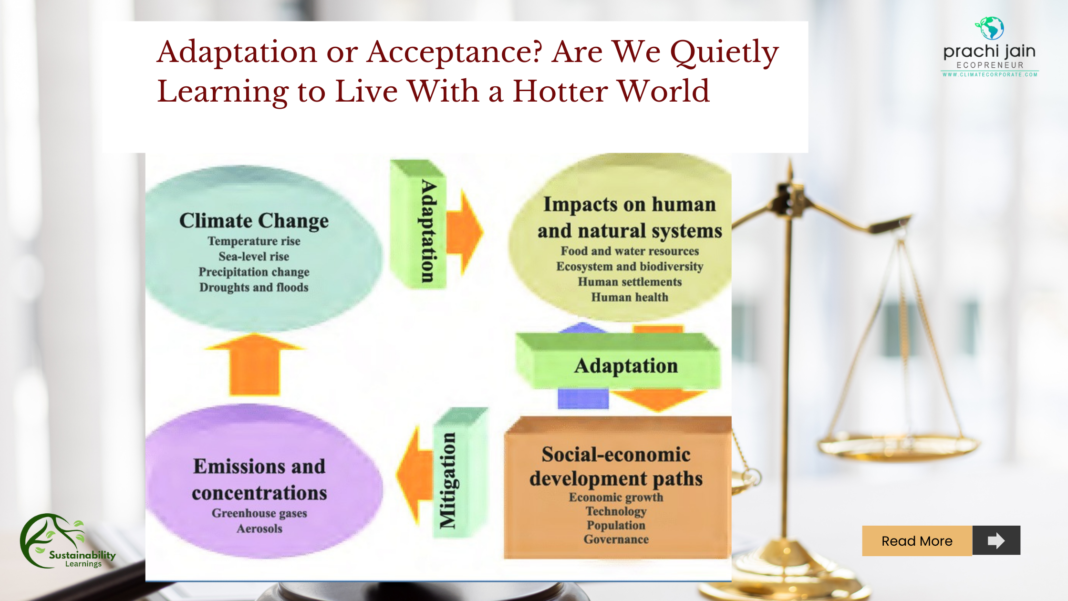
For years, climate policy revolved around one central objective: “mitigation“. Reduce emissions. Limit warming. Prevent the worst. The language of climate diplomacy was built around temperature targets and carbon budgets.
Nevertheless, as global temperatures continue to rise and extreme weather events intensify, a subtle shift is underway. Adaptation—once treated as a secondary pillar—is moving to the foreground. Governments are investing in flood barriers, heat action plans, drought-resistant crops, and resilient infrastructure. The question now confronting policymakers is no longer whether adaptation is necessary. It is whether adaptation is gradually becoming acceptance.
This shift is rooted in climate reality. According to the Intergovernmental Panel on Climate Change, the planet has already warmed by approximately 1.1°C above pre-industrial levels, and further warming is effectively locked in due to cumulative emissions. Even under optimistic mitigation scenarios, certain impacts are unavoidable. Sea levels will continue rising for decades. Heatwaves will grow more intense. Some ecosystems will not recover. Adaptation, therefore, is not optional; it is indispensable.
The scale of adaptation needs is immense. The United Nations Environment Programme’s Adaptation Gap Report consistently warns that adaptation finance falls far short of what developing countries require. Estimates suggest that annual adaptation costs could reach USD 160–340 billion by 2030, rising further by mid-century. However, actual finance flows remain a fraction of these projections. This gap reveals a persistent imbalance: mitigation attracts investment and innovation, while adaptation struggles for political urgency.
Adaptation also differs fundamentally from mitigation in how it is experienced. Emissions reductions are often measured globally; adaptation is deeply local. Flood defences protect specific communities. Urban heat plans safeguard particular neighbourhoods. Water conservation policies reshape regional agriculture. Adaptation is intimate, tangible, and immediate. It operates in the lived environment rather than in abstract targets.
India’s experience illustrates this reality. Heat action plans in cities such as Ahmedabad have reduced heat-related mortality through early warnings and coordinated responses. Coastal resilience projects aim to manage rising sea levels and cyclonic activity. Nevertheless, adaptation is uneven across regions and sectors. Rural communities facing water stress or crop failure often lack the resources needed for sustained resilience. Adaptation, without equity, risks protecting some while leaving others exposed.
Globally, the visibility of adaptation is growing. European cities are redesigning urban spaces to mitigate heat. Small island states are investing in coastal defences while simultaneously advocating for international finance for loss and damage. Insurance markets are recalibrating risk models to reflect the increasing frequency of extreme events. Each of these responses signals acknowledgement that certain climate impacts can no longer be prevented.
Nevertheless, this pragmatism carries a deeper concern. When adaptation dominates discourse, the urgency of mitigation can fade. Investments in resilience may inadvertently normalise higher levels of warming, particularly if emissions reductions stagnate. Adaptation, while necessary, can never fully compensate for an unchecked failure to mitigate. There are limits to what societies can adapt to.
The IPCC has explicitly warned about these limits. Certain ecosystems, such as coral reefs, face irreversible damage beyond specific temperature thresholds. Agricultural productivity declines under extreme heat conditions that technology cannot entirely offset. In some low-lying island states, sea-level rise may render territory uninhabitable. These realities underscore a stark truth: adaptation has boundaries.
The governance challenge lies in balancing mitigation ambition with the necessity of adaptation. Framing adaptation as defeatism oversimplifies its role. Communities require immediate protection from the climate impacts already unfolding. Nevertheless, framing adaptation as sufficient risks political complacency.
Financial systems reflect this tension. Investors increasingly assess climate resilience in infrastructure and urban planning. Development banks allocate resources toward adaptation projects. However, fossil fuel investment persists in parallel. The coexistence of adaptation expansion and fossil continuity reveals a broader policy contradiction.
Adaptation also reshapes notions of responsibility. Unlike mitigation, which addresses global emissions, adaptation often falls on those already vulnerable. Countries that contributed least to historical emissions must allocate scarce resources to climate-proofing infrastructure. This dynamic reinforces climate justice concerns. International adaptation finance is therefore not charity; it is recognition of the disproportionate burden.
Migration intersects here as well. In some cases, adaptation efforts aim to delay or prevent displacement. In others, planned relocation becomes a form of adaptation. Managed retreat from vulnerable coastlines or floodplains requires careful governance to avoid exacerbating inequality or cultural loss. Adaptation, therefore, extends beyond engineering solutions; it involves social, economic, and ethical decisions.
There is also a psychological dimension. The prominence of adaptation discourse signals collective recognition that warming thresholds once described as preventable may now be partially inevitable. This recognition can generate urgency—or resignation. Public narratives matter. If adaptation is framed as resilience in pursuit of mitigation, it strengthens climate governance. If framed as inevitability rather than mitigation, it weakens resolve.
Technological innovation plays a dual role. Climate-resilient seeds, cooling technologies, and water management systems enhance adaptive capacity. However, they cannot replace structural emissions reduction. Without mitigation, adaptation costs escalate exponentially.
The concept of loss and damage further complicates the landscape. Some climate impacts cannot be adapted to, requiring compensation mechanisms and solidarity frameworks. The establishment of dedicated funding discussions at international forums reflects the acknowledgement that adaptation alone is insufficient.
Ultimately, the distinction between adaptation and acceptance hinges on intent. Adaptation becomes acceptance when mitigation ambition diminishes, and resilience investments are treated as substitutes for decarbonisation. It remains constructive when pursued alongside aggressive emissions reduction and equity-centred governance.
Climate governance is entering a phase where prevention and preparation must coexist. The world must reduce emissions rapidly while protecting communities from impacts already locked in. Framing these goals as mutually exclusive is a false choice.
The danger lies not in adaptation itself, but in complacency. As flood barriers rise and cooling systems expand, political pressure to reduce fossil fuel dependence must not recede. Adaptation is a bridge, not a destination.
The climate crisis has evolved from a debate about future risk into a negotiation about lived reality. Societies are learning to navigate higher temperatures and altered ecosystems. Whether this learning process leads to resilience or resignation will depend on governance choices.
Adaptation acknowledges the world we inhabit. Mitigation shapes the world we will leave behind. The defining challenge of this era is ensuring that preparation for impact does not become quiet acceptance of avoidable harm.