



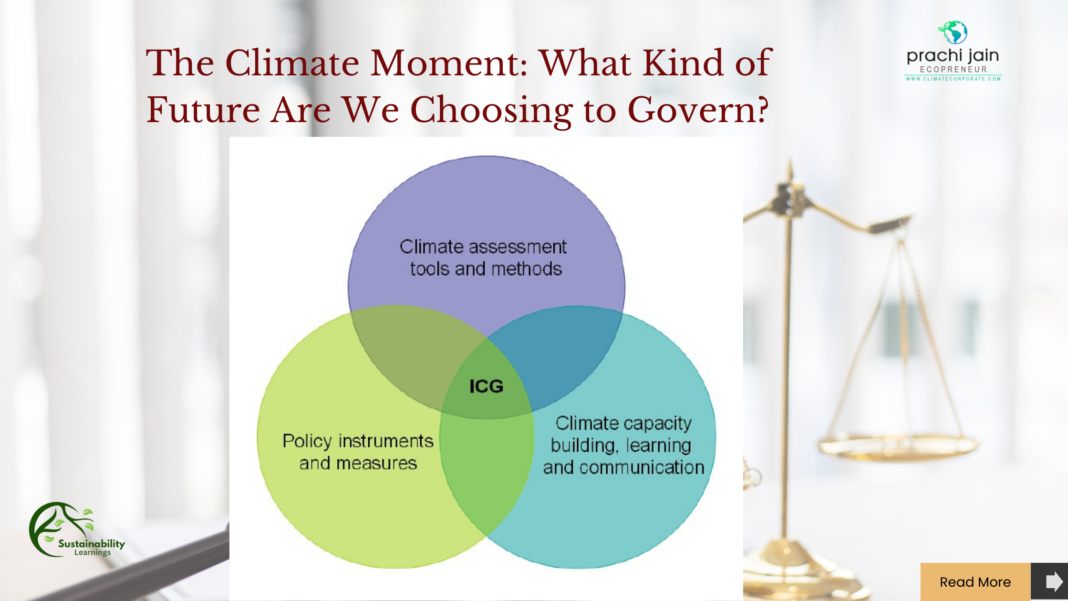
Climate change is often described as a crisis of emissions, a crisis of temperature, or an environmental crisis. After months of examining its intersections with courts, markets, cities, migration, insurance, energy, security, and adaptation, a deeper truth emerges: climate change is fundamentally a crisis of governance.
The science has been clear for years. The Intergovernmental Panel on Climate Change confirms that the planet has already warmed by approximately 1.1°C above pre-industrial levels, with escalating risks across food systems, water security, biodiversity, and economic stability. The United Nations Environment Programme continues to warn of an emissions gap between current policies and pathways consistent with internationally agreed temperature goals. The data is not ambiguous. What remains contested is the response.
This series has traced how climate stress now touches every institutional domain. Courts are stepping into policy voids. Insurance markets are recalibrating risk exposure. Security establishments describe environmental stress as a threat multiplier. Financial regulators incorporate climate risk into stability assessments. Cities develop adaptation plans while national frameworks struggle for coherence. Renewable energy grows, yet fossil fuels remain embedded in economic systems.
Taken together, these developments reveal not institutional apathy, but institutional strain.
Climate change operates across borders, sectors, and timelines. Governance systems, however, remain largely organised around electoral cycles, administrative silos, and short-term fiscal constraints. This structural mismatch defines the climate moment. Environmental change is cumulative and accelerating; political response is incremental and negotiated.
The challenge is not simply technological. Renewable energy capacity is expanding rapidly. Electric mobility is gaining ground. Climate data systems are more sophisticated than ever before. Nevertheless, technology does not automatically produce transformation. Governance determines whether innovation reshapes systems or merely supplements them.
Consider the energy transition. The International Energy Agency notes impressive growth in renewable energy, yet fossil fuels continue to dominate global primary energy supply. Subsidy structures, infrastructure investments, and geopolitical considerations slow the phase-out dynamics. The transition is real—but uneven. The difference between transition and illusion lies in political coherence.
Adaptation policies reflect a similar tension. Flood defences, heat action plans, and resilience investments acknowledge climate realities. However, adaptation finance remains insufficient, particularly for vulnerable regions. The UNEP Adaptation Gap Report underscores persistent funding shortfalls. Adaptation is necessary. It is not sufficient.
Insurance markets offer another lens. As climate-related losses rise—frequently exceeding hundreds of billions of dollars annually according to global reinsurance assessments—risk pricing changes. Coverage retreats from high-exposure areas. When insurance withdraws, vulnerability becomes tangible. Markets translate climate science into economic signals long before political consensus forms.
Security institutions now integrate climate risk into strategic planning. Water stress, food insecurity, and migration pressures intersect with geopolitical instability. Climate change is no longer peripheral to national security discourse. Nevertheless, securitisation cannot substitute for mitigation and cooperation. Defensive measures manage symptoms; structural reform addresses causes.
The justice dimension remains central. Those least responsible for historical emissions frequently bear disproportionate exposure to climate impacts. International climate finance commitments aim to address this imbalance, yet delivery gaps erode trust. Governance legitimacy depends not only on efficiency but on equity.
India’s experience illustrates the complexity of this balancing act. Rapid deployment of renewables coexists with developmental energy demands. Urban adaptation plans advance alongside rural vulnerability. Economic growth aspirations intersect with climate resilience requirements. The governance question here is not abstract—it is lived daily across sectors and communities.
Across these domains, one insight becomes unavoidable: climate change is testing the design of institutions built for a different era. Post-war governance frameworks assumed relative climatic stability. Economic planning models did not account for cascading climate risk. Fiscal systems rarely incorporate long-term environmental liabilities.
The climate moment demands institutional evolution.
This does not mean dismantling existing systems. It means recalibrating them, embedding climate risk into fiscal planning, aligning market incentives with long-term resilience, and reforming subsidy structures that entrench fossil-fuel dependence—thereby delivering climate finance commitments with credibility. Strengthening local governance capacity for adaptation, extending planning horizons beyond electoral cycles.
The temptation in periods of structural stress is either paralysis or overcorrection. Climate governance requires neither. It requires sustained, coordinated recalibration.
History offers precedent. Financial crises have led to regulatory overhaul. Public health emergencies have transformed institutional coordination. Climate change, however, differs in scale and duration. It is not a singular event but an enduring transformation of planetary systems.
The future will not resemble the past baseline around which governance systems were built. Temperature volatility, water variability, and ecological disruption will shape economic patterns and geopolitical relations for decades. The question is whether governance evolves deliberately—or adjusts reactively as crises accumulate.
There is reason for cautious optimism. Climate risk is now embedded in financial stress testing. Legal recognition of environmental rights is expanding. Renewable technologies are scaling. Adaptation knowledge is improving. Public awareness is rising.
But optimism without reform risks complacency.
The climate moment is not solely about reducing emissions or building resilient infrastructure. It is about redefining governance capacity in an era defined by systemic risk. Institutions must become more anticipatory, more coordinated, and more equitable.
The future is not predetermined by temperature trajectories alone. It is shaped by institutional choice.
Climate change forces a collective decision: will societies treat environmental disruption as a peripheral challenge to be managed within existing structures, or as a structural inflexion point requiring institutional redesign?
The answer will determine whether governance remains reactive or becomes transformative.
At its core, the climate crisis is a test of political imagination. Not imagination detached from data, but imagination grounded in evidence and equity. Science has clarified the risks. Markets have signalled vulnerability. Courts have pressed accountability. Cities have demonstrated innovation.
What remains is governance alignment.
The climate moment is not about whether change is coming. It already has. It is about whether institutions can evolve in time to shape that change toward stability rather than fragmentation. The future is being governed today. The question is whether we are deliberately governing it.